

The Toolbox Talk Isn't Working. Here's Why.
The weekly toolbox talk is one of the most consistent safety practices across construction, energy, and manufacturing. It is also one of the most consistently ineffective. The problem isn't the format. It's what the format has become.
Ask a crew how they feel about the Monday morning toolbox talk and the answer is usually some version of the same thing. It's fine. We do it every week. Someone reads from a sheet. We sign. We get on with the work.
That description is not a failure of the crew. It's an accurate account of what the toolbox talk has become at most organizations: a compliance ritual dressed up as a safety intervention.
The intention behind it is right. Regular, brief safety briefings are one of the most evidence-backed interventions in occupational safety. The research on spaced repetition is clear: short, frequent reinforcement of safety-critical information does more to keep it accessible than a single long session. The toolbox talk, in theory, is exactly the right tool.
In practice, it rarely works that way.
How it stopped working
The toolbox talk started as an informal conversation between a supervisor and their crew about whatever was relevant that morning. A near miss, a change in conditions, a hazard coming up that week. Over time it became formalized: standard templates, pre-written topic libraries, sign-off sheets. Those additions made sense for auditability. They had an unintended consequence.
When the format became fixed, the content became generic. A pre-written topic gets delivered regardless of whether it applies to that crew that week. The talk happens, the sheet gets signed, and the crew's actual risk profile is unchanged.
Three things compound the problem. The topic often isn't relevant to what the crew is actually doing. The format is so predictable that workers tune it out before it starts. And it ends with a signature rather than a check; proving attendance, not understanding.
What a toolbox talk should look like
The fix is not a new template. It's a return to the original purpose: a brief, specific, relevant conversation between a supervisor and their crew about the actual hazards they're about to face.
Specific to today's work. The topic should follow the crew, not the calendar. If the crew is working in a confined space this week, the briefing should cover confined space hazards, not the pre-written topic that happened to come up in rotation.
Short enough to hold attention. Five minutes of focused, relevant content lands better than fifteen minutes of material that half the crew has tuned out. Brevity is not a compromise. It's the point.
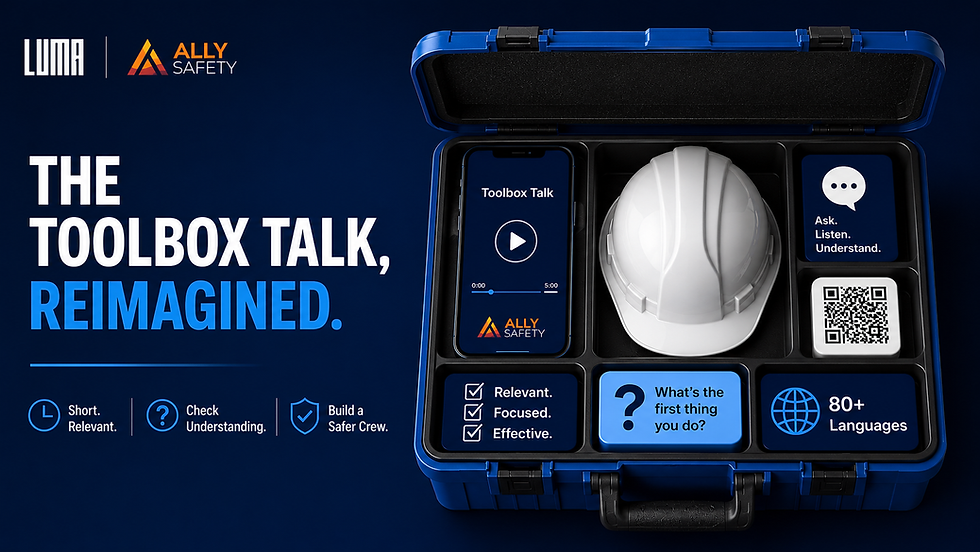
Closed with a question, not a signature. "What's the first thing you do if the atmosphere monitor goes off?" takes thirty seconds to ask and immediately reveals whether the content landed. That question is more valuable than a signed sheet.
How LUMA1 makes this practical
Part of the reason toolbox talks stop landing is the content itself. Generic, dry, and easy to tune out. That's where the Ally Safety video library comes in. LUMA1 partners with Ally Safety, a safety training studio built around a simple idea: training people will actually watch is training that actually works. Their library of 200-plus short-form toolbox talk videos is genuinely watchable. Short, sharp, and led by a Certified Safety Professional who knows the material. It's the content side of the problem solved.
LUMA1 handles the delivery. Content can be assigned by scope, site area, or task, so the briefing a crew receives reflects their work that week, not a rotation schedule. Every briefing includes a comprehension check, not just a completion record. LUMA1 can also voice and deliver content in 80-plus languages, reaching workers in their first language without rebuilding the content from scratch.
And because LUMA1 is app-less, the briefing reaches workers through whatever channel they already use, WhatsApp, SMS, QR code, email, or LMS. No new login. No new app. The talk arrives in the channel the crew already checks, which means fewer excuses for not seeing it before the shift starts.
The toolbox talk doesn't need to be replaced. It needs to be relevant again. Book a demo at luma1.com to see how.


Comments